To the Académie des Inscriptions et Belles Lettres
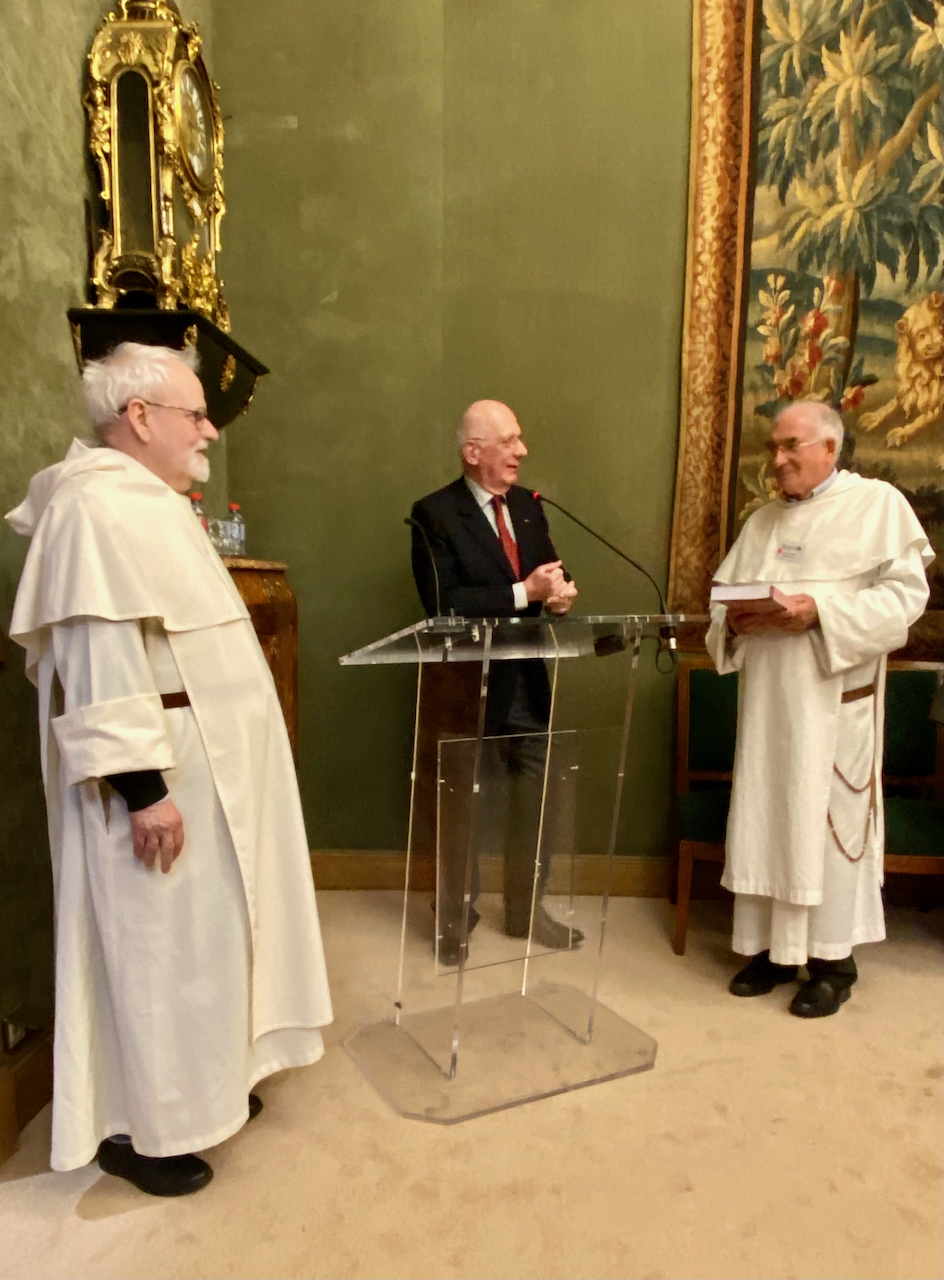
On March 6, a delegation from the École Biblique de Jérusalem was received at the Institut de France by the Académie des Inscriptions et Belles-Lettres (AIBL) as part of the celebration of the centenary of the École’s recognition as a French archaeological school. The theme of the day was “Reporting and transmitting a taste for the Orient”. The morning’s colloquium gave way to the weekly session of the Academy in the afternoon. The School proposed a rich report.
A special tribute was paid to Br. Marcel Sigrist, former director of the School, who worked from the beginning on The Bible in its Traditions and never ceased to encourage it. Ad multos annos!
In addition to several friends of Sources chrétiennes, we saw again, among others, Prof. Marie-Françoise Baslez, whose work is still in progress. Marie-Françoise Baslez, whose important contribution to our Judith we had just finished integrating, after those she had made to the Philippians, but also Dr. Matthieu Richelle who was elected this year as professor of Old Testament at Louvain-la-Neuve.
From the Institut des Sources Chrétiennes, in Lyon
The workshop on Qohelet initiated by Dr Laurence Mellerin has resumed:
Prof. Guillaume Bady has just sent us his first fascinating notes. Guillaume Bady has just sent us his first fascinating notes, dealing in particular with the patristic reception of the three “Solomonic” works of the biblical corpus…
On the occasion of his intervention for the 120th anniversary of the École Biblique et Archéologique Française at the Académie des Inscriptions et Belles Lettres, our dear colleague proposed a very useful and interesting synthesis on “Des boursiers patrologues à l’École Biblique et Archéologique Française de Jérusalem” (Patrological scholars at the École Biblique et Archéologique Française de Jérusalem)… where our research programme appears to be a real place of dialogue between biblical and patristic sciences.
Publications
Two ‘former’ assistants publish :
- Ottilia Lukacs, Sabbath in the Making (Contributions to Biblical Exegesis & Theology, 97), Leuven: Peeters, 2020.
- Daniela Scialabba (PBI, Rome) announces the publication of the latest volume of the magazine Henoch edited by Françoise Vinel and herself: “La Sagesse au carrefour des Nations”,Henoch Journal 42 (2020)Brescia: Morcelliana.
Collaborators are announcing great achievements online:
- Régis Burnet and several colleagues remind us of the publication of the excellent “Die Bibel in der Kunst (BiKu) / Bible in the Arts (BiA)” .
— Why not add to this the consultation of the more anecdotal and sometimes confusing Visual Commentary of Scripture ? - Eberhard Bons reports that the first volume of the lexicon “Historical and Theological Lexicon of the Septuagint” (lettres alpha à gamma) is available.